
What problem are you really solving with your fancy new AI feature?
Building in the AI world is increasingly less about building what your customers say they want - and increasingly more about understanding what they need.


I’ve been speaking with customers lots recently about how other products they use regularly are slapping them in the face with AI add-ons they never asked for.
What’s becoming incredibly obvious to me is that the breadth of your product value in an AI build world is heavily dependent on the depth of understanding of what your customers really need - which is very rarely what they say they want- and solving the fundamentals first.
Throwing AI features and the wall and hoping something sticks is not just going to be a waste of time, but a surefire way of pissing your current customers off.
Verbatim from a customer:
“They know they have add-on AI, but I feel like everything I’ve asked for for years has just been ignored. Why would I waste my time telling them my thoughts now?”
To get better at this at Elyos, we’re doing these things:
Taking input from customers, but not too literally.
Dogfooding
Product groups with selected users
Do customers actually know what they want?
One of the challenges we’ve been having is that the requests we get from customers are usually quite simple. And it feels like we’re not digging deep enough.
In an AI-native world, customers shouldn’t be relied on to come up with the solution - how should they even know what’s possible - that’s an unfair expectation.
But. They do know what their problems are, and this is where you listen and learn.
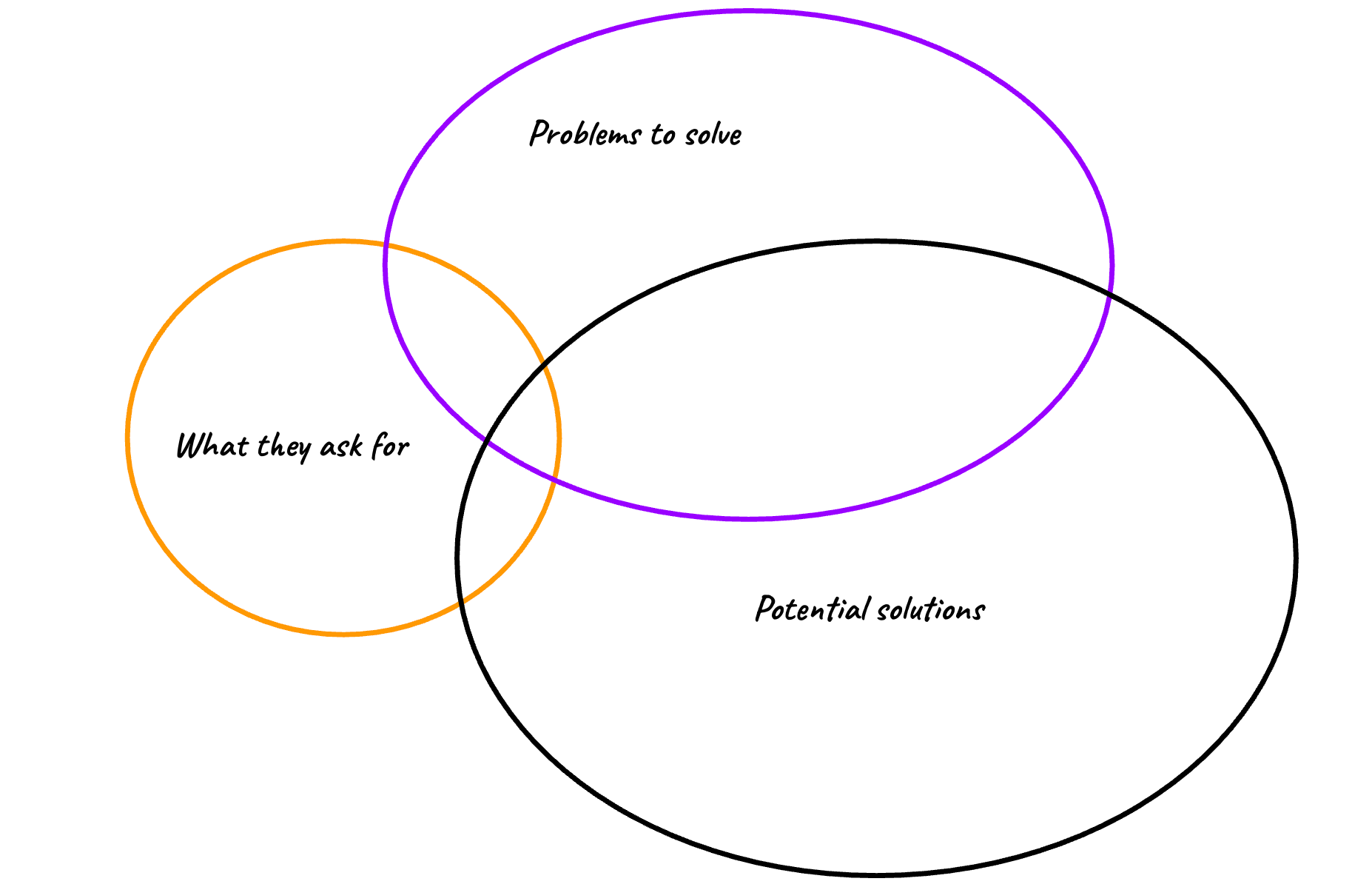
The potential solutions are huge. The “capability frontier” has moved. A customer can only imagine what they’ve already seen, & that’s not their fault.
But if you build what they ask for, you’ll ship a 2022 product. For example:
“I want a better search”: when an agent could just do the work
“I need to export to share this” when the Agent could send the email itself
“Can you build a faster form”: when the form shouldn’t exist
Dogfood. Properly.
We’ve started building products for use internally first. The fastest way to develop your own taste is to use your own product. Not a staged demo. Not a sandbox. Real work.
Our engineering team is getting live feedback from our customer success team daily, on things that are broken, features that aren’t optimised yet, why we want different UI. It’s like unlimited customer data.
If it doesn’t work for us then why would it be good enough for our customers?
Product working groups
We run product building groups with real customers. The customers are in it for the same reason we are: they believe in Elyos. And I guess they want first access to new features.
Real reactions to product
A check on whether we’re building for one loud voice or the broader pattern
Trust: people who help build something become the people who champion it
It doesn’t replace listening to every other customer. But it does mean we’ve got a tight loop of people who’ll tell us when we’re wrong, fast.
So - do customers know what they want?
Not really. But they still know more than you do.